1.2 The Piezoelectric Transducer
The watershed between microphone-based amplification and direct amplification of the classical guitar (with nylon strings) was marked by the introduction of the piezoelectric transducer. This development took place around the 1960s, a period when electric guitars had already reached a high degree of reliability. As far as steel-string acoustic instruments were concerned, the problem of amplification had largely been solved through the use of magnetic pickups and suitable amplification systems, as exemplified by the instruments produced by C. F. Martin & Company.
The situation was quite different for the nylon-string guitar. In this case, magnetic pickups proved unsuitable, as they significantly altered the instrument’s natural sound. As a result, the amplified tone remained unsatisfactory.
Within this context, the piezoelectric sensor gradually emerged as the preferred solution. It enabled the amplification of vibrations directly from the body of the instrument without substantially altering its timbral characteristics. However, the signal generated by the transducer exhibits a very high impedance, making direct connection to conventional amplifiers or audio systems ineffective. For this reason, a preamplifier is required to condition the signal by reducing its impedance and ensuring a stable output compatible with subsequent amplification stages.
The piezoelectric pickup should therefore be regarded as a system consisting of two complementary components: the transducer itself, which converts mechanical vibrations into an electrical signal, and the preamplifier, which is essential for the proper transmission and amplification of that signal. The interaction between these two elements makes it possible to achieve effective amplification while preserving, as much as possible, the original acoustic character of the guitar.
(French, Engineering the Guitar: Theory and Practice, pp. 223–232).
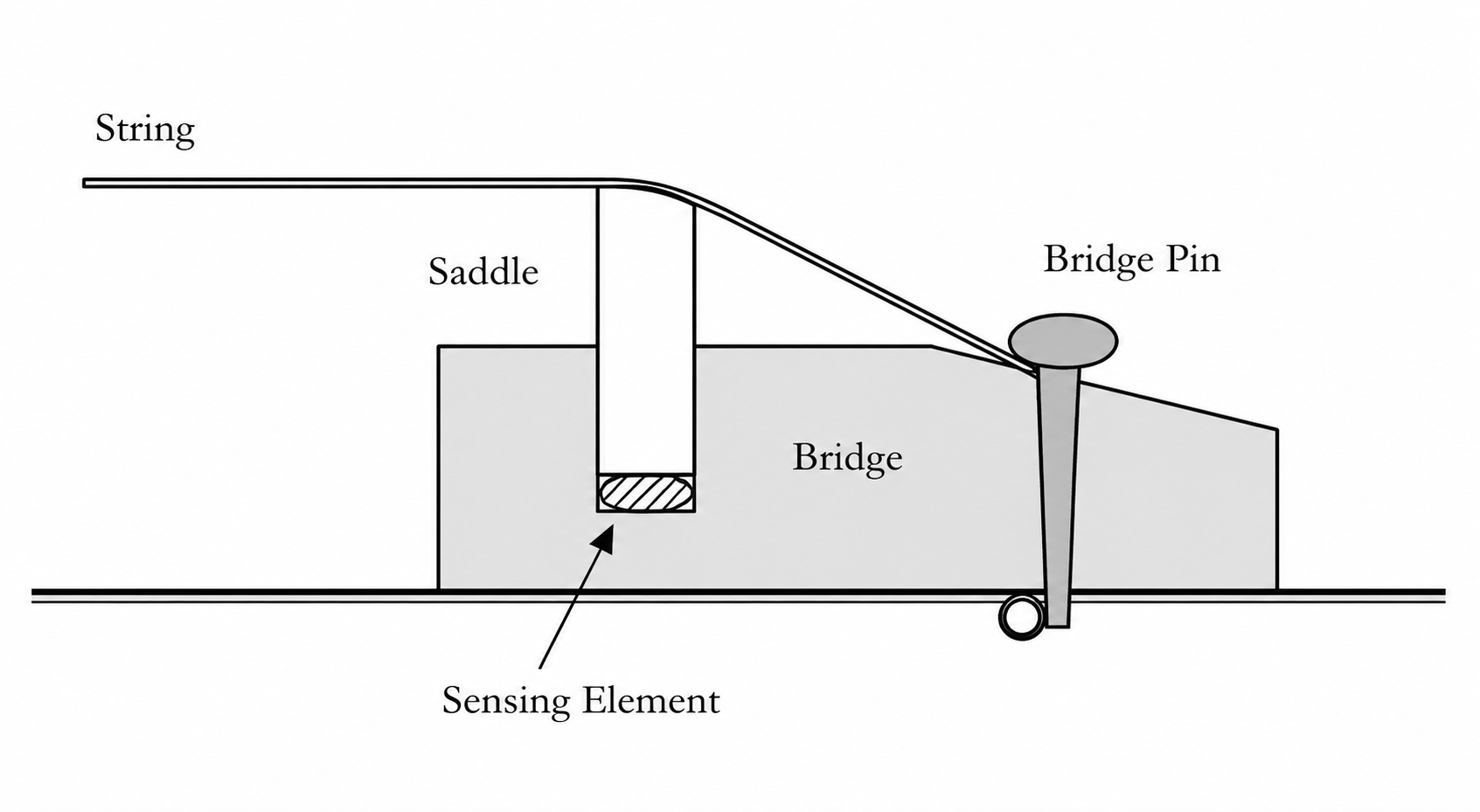
Fig. Pickup piezo (F.M.French)
The American company Ovation Guitars, founded by Charles Kaman, was among the first manufacturers to make systematic use of piezoelectric pickups, initially on acoustic instruments.
Ovation’s 1971 patent, attributed to James H. Rickard, also references several pioneers in the application of piezoelectric technology to musical instruments, including Hugo Benioff and Chauncey Richard Evans. Ovation subsequently developed nylon-string guitar models equipped with piezoelectric systems capable of isolating the signal from each individual string, effectively creating hexaphonic pickups.
The use of piezoelectric technology was not confined to Ovation. In the following years, similar solutions were adopted by a number of manufacturers, including Takamine [ Takamine Guitars :: Palathetic Pickup ], Yamaha, and Washburn. Particular mention should also be made of the solid-body instruments produced by the German company Shadow and the guitars manufactured by the Canadian company Godin, many of which were equipped with LR Baggs and Fishman pickup systems.
The 1980s marked the definitive transition toward the standardization of piezoelectric technology in musical instruments. During this period, Lead Zirconate Titanate (PZT), a piezoelectric ceramic material, emerged as the industry standard for sensor construction.
Building upon this technology, manufacturers developed a variety of electronic circuits and preamplification systems designed to compensate for the characteristic tonal properties of piezoelectric pickups and to reproduce, as faithfully as possible, the natural acoustic sound of the guitar when amplified.